Skip to content

Blog

See how it works — internal navigation link

Withdrawn: We Measured the Ads in 60,000 Podcast Episodes

ZeroAds does one job: you give it a podcast’s RSS feed, it cuts the ads out of the audio, and it hands back a clean private feed for the app you already use. Doing that job sixty thousand times leaves a record. Every ad we cut is logged with timestamps, per episode, per show.

That record is now big enough to be worth publishing. We pulled the numbers on July 8, 2026. Here’s what podcast ads look like from inside the audio.

  • 60,536 episodes with ads removed
  • 5,398 hours of ads cut. Played back to back, that’s about 225 days of nonstop advertising.
  • Median: 4.3 minutes of ads per episode.
  • Average: 5.4 minutes. The gap between those last two numbers is the story.

Study headline numbers and distribution: 60,536 episodes measured, 5,398 hours of ads removed, median 4.3 minutes of ads per episode, above a histogram of ad minutes per episode that peaks at two to four minutes, with 13% of episodes above ten minutes

People asked to see this as a share of runtime instead of minutes, so here it is (measured again this week, n = 60,874): the median episode is 10.2% ads.

Histogram of ad time as a percent of episode runtime across 60,874 episodes: the median episode is 10.2% ads, the most common bucket is six to eight percent, and 17% of episodes are at least one-fifth ads

The distribution leans low. 13,987 episodes (23%) carried under two minutes of ads, and the most common load was two to four minutes. If that were the whole picture, podcast ads would be a shrug.

The tail is the rest of the picture. 7,897 episodes, 13% of everything we processed, carried more than ten minutes of ads. 639 episodes carried more than twenty minutes. 126 carried over half an hour of ads in a single episode. Each of those is a specific episode of a specific show, and if your subscriptions lean the wrong way, that tail is your commute.

Take the median, 4.3 minutes, and a listener who gets through eight episodes a week. That’s about 34 minutes of ads a week, close to 30 hours a year, inside shows they chose on purpose. Follow heavier shows and the number climbs fast. Which brings us to the table.

This section contained a table ranking 16 shows by measured ad load. We have removed it, and it should not be reproduced from cached copies.

The table was the least defensible thing in the study. Ranking shows by the ad load our own detector measured means the ranking preferentially surfaces the shows the detector fails on: a show reaches the top either because it genuinely carries a lot of ads or because we mis-cut it, and the table cannot tell those two cases apart. Independent figures from Podscribe for the shows we placed highest are roughly half of what we published.

The CSV download has been removed for the same reason.

Don’t quote this. See the correction at the top.

For the record, the caveats we did publish were these: our data covers the shows our users chose to clean, which skews toward talk-heavy US shows, so this was a measurement of our catalog and not of podcasting overall. Industry benchmarks (Magellan AI among them) put average ad load around 5 to 8 percent of runtime. Podcast ads are inserted dynamically at download time, so these figures described the copies we processed at the moment we processed them.

The caveat we failed to publish is the one that mattered: we never measured how often the detector cuts something that isn’t an ad.

Ads are how most of these shows get made; the minutes in that table pay salaries. So this data is a measurement, not an accusation. On our side, we’re building revenue sharing so the shows our subscribers listen to most get paid from subscription money. Until that ships, the plain description of ZeroAds is that we work for the listener.

Is any of this still valid? Treat none of the ad-load figures as valid. The direction of the error is up: we cut things that were not ads and counted them as ads, so the real numbers are lower than what we published, by an amount we have not yet measured.

What exactly was the bug? The detector cuts a block from the start of an episode more often than it should, and cuts it too long. A pre-roll ad is typically 15 to 60 seconds. Across the data behind this study, 21% of our leading cuts ran over two minutes. On James Cridland’s episode it ran 130 seconds and removed the entire opening news segment.

Were paying customers affected? Yes. This is a product bug, not only a data-reporting one. If we removed part of a show you were listening to, that is the same bug, and fixing it is our first priority.

Which figure do you now believe? None of ours, until we re-measure. Where independent numbers exist, use those. Podscribe publishes podcast ad load and their figures for the shows we ranked highest are roughly half of ours.

When do you republish? When we can state a false-positive rate next to every number. Not before.

How we measured the ads in 60,536 podcast episodes. Snapshot date: July 8, 2026.

ZeroAds sells ad removal, which means every number in the study comes from a company with something to gain. Read it that way. This page is the full method, including the parts that cut against us. For what it’s worth, the central finding (most episodes carry a modest two to four minutes of ads) is not the number a marketing department would have ordered.

When a user adds a show, our pipeline downloads each episode, transcribes it, and runs a two-pass classifier over the transcript to mark ad segments. Marked segments are cut from the audio, and every cut is logged with start and end timestamps. The study is that log, aggregated: 60,536 episodes with at least one ad removed, 5,398 hours of ad time, as of July 8, 2026. We measure what we actually cut: edits to specific audio files, logged as they happen. No part of the study is a model’s estimate of a market.

Whatever the classifier marks as advertising: ads inserted into the episode by an ad server, and sponsor segments recorded by the show itself. Both get cut, both get counted.

The sample is every episode processed on our platform. Users pick the shows, so it skews toward what our users listen to: talk-heavy, US-centric programming. People also come to us for the shows that annoy them, which overweights heavy shows. That’s selection bias and we can’t correct for it, so treat every number here as a description of our catalog. For the market-wide picture, industry benchmarks (Magellan AI among them) put average ad load around 5 to 8 percent of runtime. Nothing in our data contradicts that.

Most podcast ads are stitched into the file at download time, per request. Two listeners downloading the same episode can get different ads in different amounts. Our figures describe the copies our pipeline downloaded, at the moments it downloaded them. Download the same episode again today and the ad minutes can shift. The distribution is stable across 60,000 episodes; any single data point is one copy’s snapshot.

Why the totals undercount ← this section was wrong

Section titled “Why the totals undercount ← this section was wrong”

This is the passage that broke the study, so it stays up, quoted exactly as published:

We only count an ad if we caught it. Detection is verified at 90%+, and in our accuracy tests (against hand-labeled episodes) the pipeline catches about 97% of ad segments. That’s a test result, not a guarantee, and it’s about what we remove, so anything that slips through appears in no log and no total. Every aggregate in the study is a floor. True ad time sits somewhat above what we report.

Every sentence there is about recall: how much of the advertising we manage to catch. The conclusion drawn from it (“every aggregate is a floor”) is a claim about precision: that we hardly ever cut anything that isn’t an ad. Recall does not imply precision. A detector can catch 97% of the ads and still cut minutes of the show along the way, and ours does.

We had no precision measurement at all. We did not have one when we published, and we did not notice we were missing one. The honest statement would have been that we did not know the direction of the error. Instead we asserted the direction that flattered us.

The table is gone; see above. For the record, the inclusion rule was mechanical (20 or more measured episodes, no editorial exclusions), and that part was true. A mechanical rule applied to a biased measurement still produces a biased table.

The median episode carries 4.3 minutes of ads; the average is 5.4. The average sits higher because the tail is heavy: 13% of episodes carry more than 10 minutes, and 126 episodes carried over half an hour. When one number has to stand for the dataset, we use the median.

It says nothing about shows nobody has added to ZeroAds. It can’t tell you which ad server or network placed a given ad beyond what’s audible in the file. We didn’t measure listening behavior, only episode contents. And it isn’t evidence that podcast advertising is exploding: industry ad revenue grows around 18 percent a year (IAB/PwC), while per-episode ad load market-wide stays flat to slightly down. Our tail numbers show how uneven the load is. They say nothing about growth.

This was the original offer, and it stays:

If you find an episode where our numbers look wrong, send it over. We’ll check it against the audio, and if we got it wrong we’ll say so in public.

Someone did, we did, and this page is us saying so. The offer is open. If you have an episode where our cut looks wrong, send it and we will check it against the audio.

The charts and the table have been withdrawn and should not be reused. The CSV download has been removed. If you have republished any figure from this study, please link to this correction.

Apple Podcasts Ads: Why Every Show Has Them (and How to Remove Them)

Apple doesn’t put ads in your podcasts. The shows do.

Every ad you hear in Apple Podcasts was either read by the hosts or stitched into the audio file by the show’s hosting service before the episode reached your phone. Apple Podcasts just plays the file it’s given. That’s why switching podcast apps never fixes the ads: the ads travel inside the audio.

Two sources:

  1. Host-read ads. The hosts pivot to a mattress or a meal kit mid-episode. These are recorded into the show itself.
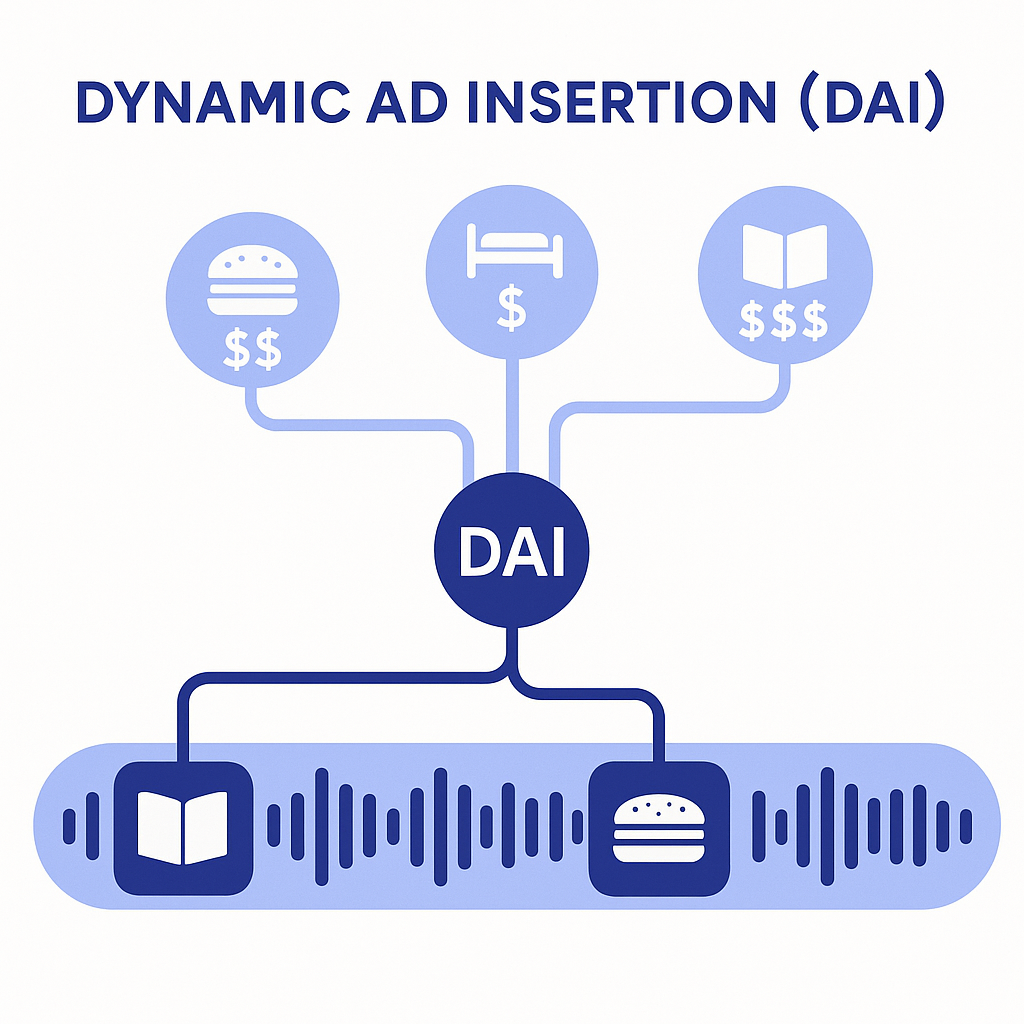
  2. Dynamic ad insertion (DAI). The hosting service assembles a fresh copy of the episode each time it’s downloaded and stitches in ads chosen for you: your region, your device, whatever the ad market pays for that day. It’s why an episode from 2022 suddenly carries ads for a phone released last month, and why you and a friend hear different ads in the same episode. More on the mechanics: what is dynamic ad insertion?

The heaviest feeds we’ve measured are daily radio shows repackaged as podcasts, which run 30 to 44 percent ads; the full table is in our study of 60,000 episodes.

Apple’s per-show subscriptions are the official escape hatch, but they’re per show: a few dollars a month, each, set by the creator. Follow ten shows and the math stops working.

Here’s the part that surprises people: Apple Podcasts is one of the best apps to go ad-free in, because it accepts custom RSS feeds. (Library > Follow a Show by URL. Spotify has no equivalent; that door is locked.)

That’s the whole trick behind ad-free feed services:

  1. ZeroAds fetches each new episode of your shows and finds the ad segments in the audio, at 90%+ verified accuracy.
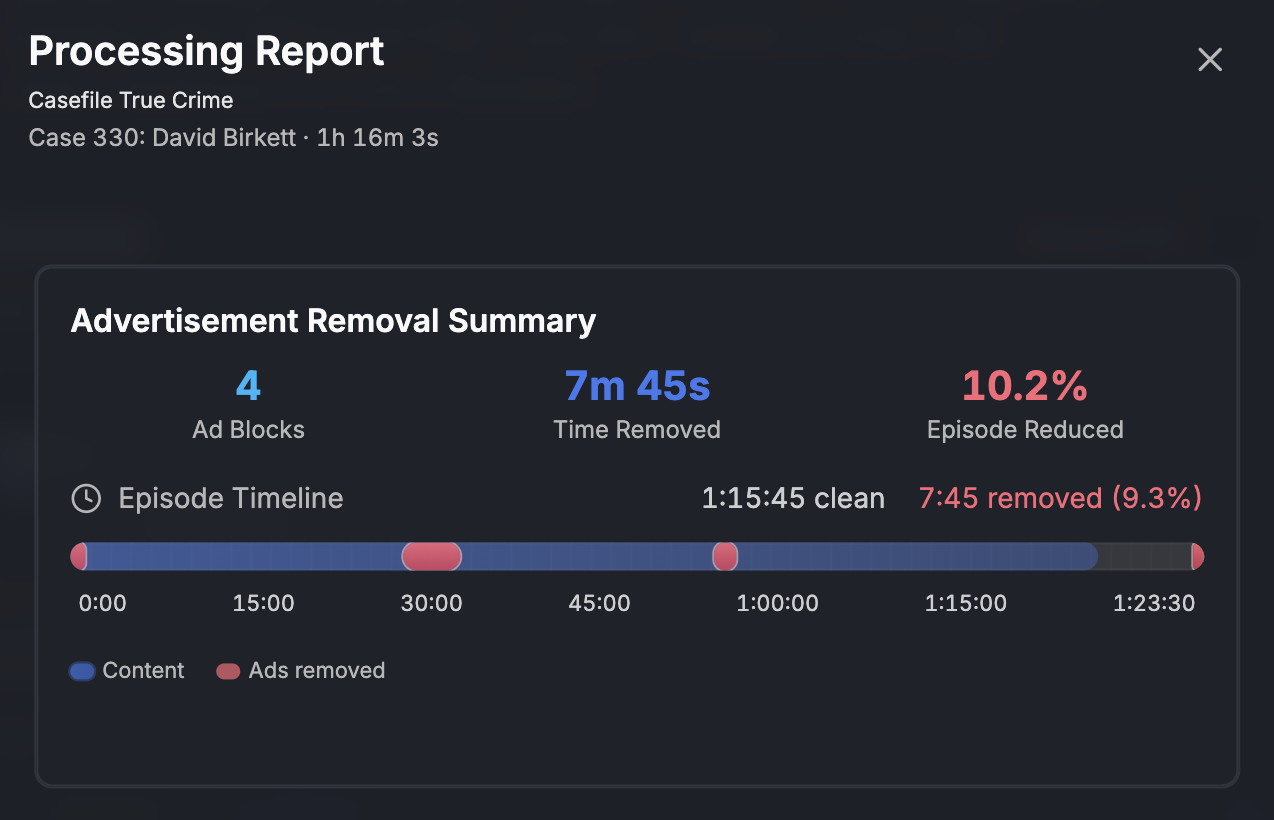
  2. It cuts them out and rebuilds the episode. Every cut is listed with timestamps in an episode report, so you can check its work.
  3. You get a private RSS URL. Paste it into Apple Podcasts once, and episodes arrive already clean.

Same app, same shows, same queue. The ads just aren’t in the file anymore.

Hear it on your own shows. Try ZeroAds. Your first 5 episodes are free

Step-by-step setup for this app: remove ads in Apple Podcasts.

  • Ad blockers. They filter web requests. Podcast ads are inside the audio stream, so there’s nothing to block. (Full explanation.)
  • Paying for other Apple services. Apple One, Apple Music, iCloud+: none touch podcast ads, because the ads were never Apple’s to remove.
  • Skip buttons. They work, thirty seconds at a time, every episode, forever. Fine on the couch. Worse on a run or while driving.

For the complete rundown of every option, including our competitors: how to remove podcast ads in 2026.

Podly vs ZeroAds: Self-Hosted or Hosted Podcast Ad Removal?

Podcast ads are baked into the audio file, so removing them means processing the audio: transcribe, find the ad segments, cut them, re-serve the episode as a clean RSS feed your podcast app can read.

Podly and ZeroAds both do exactly that. The difference is who runs the machinery.

Full disclosure, and it’s a friendlier story than most versus pages: ZeroAds started as a fork of Podly. It has since grown into its own system (a two-pass classifier we score against hand-labeled test episodes, timestamped cut reports, episodes processed once and shared across all listeners), but the lineage is real: we’ve sent improvements back upstream, and Podly’s own README lists ZeroAds in its cost breakdown as the hosted option. So this isn’t two strangers fighting over a keyword. It’s the same family tree, and ZeroAds is the branch that became a service. Podly is genuinely good, this category more or less starts with it, and for a certain kind of person it’s the right choice. Here’s the honest split.

Podly is open source and self-hosted. You clone it, stand it up on a server (there’s even a one-click Railway deploy template), plug in your API keys for transcription and LLM classification, and point your podcast app at the feeds it generates.

What that gets you:

  • Control. Your server, your models, your data. Swap the LLM, tune the prompts, read the code.
  • No subscription. The software costs nothing.
  • A good project. If you have a homelab and enjoy this, it’s a satisfying one.

What it costs instead:

  • Infrastructure. A VPS or a machine that’s always on, roughly $5-10/mo unless you already run one.
  • API usage. Transcription and classification are real compute, billed per episode by your AI provider.
  • You’re the operator. Updates, breakage after a dependency bump, feeds that stop parsing, episodes that need reprocessing. Nobody’s on call but you.

If you already self-host half your life, none of that scares you, and Podly’s marginal cost is basically API calls. Go with our blessing. (The project also runs a small pay-what-you-want preview server, listed in its README, if you want a taste before deploying anything.)

Choose ZeroAds If You Just Want Clean Feeds

Section titled “Choose ZeroAds If You Just Want Clean Feeds”

ZeroAds is the hosted version of the same idea: paste a show’s RSS URL, get back a private clean feed for the app you already use (Apple Podcasts, Overcast, Pocket Casts; not Spotify, which blocks custom feeds).

What you get for $5.99/mo at the founding rate ($7.99 after the first 500 members):

  • No machinery. No server, no API keys, no maintenance. Setup is pasting one URL, about two minutes.
  • Verified accuracy. A two-pass classifier with 90%+ verified detection; in our accuracy tests against hand-labeled episodes, it catches 97% of ad segments.
  • Receipts. Every cut appears in an episode report with timestamps, so you can check exactly what was removed. Nothing is cut silently.
  • Shared economics. Popular episodes are processed once for everyone, so new episodes of big shows are usually ready within minutes. That pipeline has now measured the ads in more than 60,000 episodes; we published what it found.

And you can hear the result before paying anything: the first 5 cleaned episodes are free in the web player.

Try ZeroAds on your own shows

PodlyZeroAds
PriceFree software; you pay server + API usage$5.99/mo founding rate
SetupServer, API keys, configPaste one URL
MaintenanceYoursOurs
DetectionDepends on the models/keys you configure90%+ verified; 97% in our accuracy tests
Cut transparencyLogs on your serverTimestamped per-episode report
Data locationYour infrastructureOur cloud
Works inAny RSS podcast appAny RSS podcast app (not Spotify/Amazon Music)
Try firstFree (your time is the cost)5 free episodes

Podtastic is a full podcast app for iPhone and Android with AI ad-skipping built in. They call it Smart Jump Ahead, and it draws partly on aggregated listener data. Instead of handing you a cleaned feed, it jumps over the ads during playback, and that works even on episodes you’ve downloaded.

Two things it does genuinely well. It’s cheaper: about $36 a year ($2.99/mo billed annually), with a free tier covering two shows. And a skip that happens in the player is recoverable in the moment. If it jumps too far, you tap back and hear what you missed. Feed-based removal can’t offer that mid-episode. Our answer is the episode report, which lists every cut with timestamps so you can check what was removed after the fact. And the first 5 episodes are free, so you can judge the cuts before paying.

The tradeoff is the same one Herd asks you to make: Podtastic is the player. If you’re happy switching apps, it’s a fair pick and the price is honest. If your years of Overcast or Pocket Casts settings are staying put, a clean feed in the app you already use is the whole point of ZeroAds.

Same category, different customers. Podly is a tool you operate; ZeroAds is a service you subscribe to. If the phrase “docker compose up” sounds like a fun Saturday, start with Podly. If you got here because you’re tired of hearing the same three ad reads on your commute and you’d rather not adopt a server to fix it, that’s exactly who we built ZeroAds for.

Every other option (Herd’s player app, creator subscriptions, skip buttons) is covered in the full guide to removing podcast ads.

Does Spotify Premium Remove Podcast Ads? (No, Here's Why)

No. Spotify Premium removes ads from music, not from audio podcasts. The podcasts you listen to keep their ads whether you pay or not.

There’s one exception: since January 2026, Premium removes ads from some eligible video podcasts (Partner Program shows, in the US, UK, Australia, and Canada). If you’re hearing ads in an audio show, that exception doesn’t help you. It isn’t a bug either.

Three reasons, none of them accidental:

  1. Podcast ads are a separate business. Your subscription covers music licensing. Podcast ads are sold on a different market, by different people, at different prices.
  2. Most ads aren’t Spotify’s to remove. Shows insert ads into the audio file itself through dynamic ad insertion at the hosting level. The ad reaches Spotify already baked in.
  3. Creators earn from ads regardless of your plan. Removing them would mean paying creators out of your subscription. Spotify does exactly that for eligible video podcasts, and only there.

So “Premium = ad-free” was always a music promise. It just doesn’t say that on the label. What that leaves in place is measurable: we’ve cut more than 5,000 hours of ads out of 60,000 episodes.

No. Spotify doesn’t accept external RSS feeds, so there’s no way to swap in a clean version of a show. Ad blockers don’t work either. The ads are inside the audio stream, not separate requests a blocker could filter.

If you want ad-free audio podcasts, the listening has to happen outside Spotify:

  1. Pick a standard podcast app: Apple Podcasts, Pocket Casts, Overcast, Podcast Addict, or any app that accepts an RSS URL. (Moving your shows off Spotify takes about 20 minutes.)
  2. Get a clean feed. ZeroAds detects the ad segments in each episode’s audio at 90%+ verified accuracy, cuts them out, and gives you a private ad-free RSS feed.
  3. Add the feed to your app and listen as usual. Same shows, same app mechanics, no ads.

Hear it on your own shows first. Try ZeroAds. Your first 5 episodes are free

For speed-listening tricks, per-creator subscriptions, and the full comparison of what works and what doesn’t, see the complete guide to removing podcast ads.

Is There a Podcast App That Skips Ads? (2026)

The podcast app that skips ads is the one you already use, once the ads are gone from the feed.

No app can do it alone. Podcast ads are stitched into the audio file itself through dynamic ad insertion, so from the app’s point of view, an ad and your host’s voice are the same thing: audio. There’s nothing to detect, so there’s nothing to skip.

That’s why every “ad-skipping app” you’ve tried does something weaker than what its name suggests.

Overcast (iOS): Smart Speed shortens silences between words, and you can set custom skip-forward buttons. Useful. But you’re skipping manually, every ad, forever.

Pocket Casts (iOS/Android): Trim Silence and variable playback speed. Same story: the ads play, just faster.

These are quality-of-life features, not ad removal. You still hear every mattress read.

Remove them before the episode reaches your app:

  1. ZeroAds processes each episode’s audio, finds the ad segments with 90%+ verified accuracy, and cuts them out.
  2. You get a private, clean RSS feed for each show.
  3. You add that feed to the app you already use. Apple Podcasts, Overcast, Pocket Casts, Podcast Addict, anything that accepts an RSS URL (47+ apps). The two that don’t: Spotify and Amazon Music.

Your app, your queue, your playback settings, minus the ads.

Try it on your own shows. First 5 episodes free

Step-by-step guides:

Or start with the complete guide to removing podcast ads.